Summary

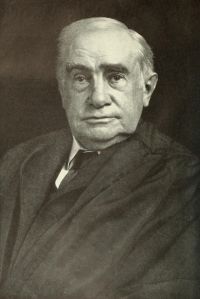
Portrait of Henry Billings Brown Henry Billings Brown Nathan Murphy v. James Utter — Opinion of the Court

Unless we are to take the position that the repeal of a territorial act operates as a repeal of an act of Congress covering the same subject, it is impossible to deny that the congressional act of 1890 is still in force. Had the latter been a mere amendment of the territorial act, the result would have been different, and a repeal of the original operated as a repeal of the congressional amendment.
Source: Wikisource

Portrait of Henry Billings Brown Henry Billings Brown Nathan Murphy v. James Utter — Opinion of the Court

When the personal duty exists only so long as the office is held, the court cannot compel the defendant to perform it after his power to perform has ceased. And if a successor in office may be substituted, he may be mulcted in costs for the fault of his predecessor, without any delinquency of his own.' This language has evidently but an imperfect application to a case where the delinquency is not personal, but official, and the action is not that of an individual, but of a body of men in their collective capacity.
Source: Wikisource

Portrait of Henry Billings Brown Henry Billings Brown Nathan Murphy v. James Utter — Opinion of the Court

Justice Strong: 'But no matter out of what facts or relations the duty has grown, what the low regards and what it seeks to enforce by a writ of mandamus is the personal obligation of the individual to whom it addresses the writ. If he be an officer, and the duty be an official one, still the writ is aimed exclusively against him as a person, and he only can be punished for disobedience.
Source: Wikisource

Get perspective with Kwize: daily news enlightened by great literature