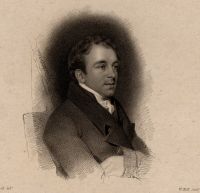
Henry Grey Bennet

Henry Grey Bennet

Summary

Portrait of Henry Grey Bennet Henry Grey Bennet On the Island of Teneriffe (1814)

On the road are several small conical hills or mouths of extinct volcanoes, the decomposed lava on the edges of these craters having a strong red ochreous tint; by degrees the lava becomes more and more covered by a small ash, and the masses or heaps of pumice gradually increase, till the surface is completely concealed. At length an immense undulated plain spreads itself like a fan, on all sides, nearly as far as the eye can reach, and this plain is bounded on the west south-west, and south south-west, by the regions of the peak
Source: Wikisource

Portrait of Henry Grey Bennet Henry Grey Bennet On the Island of Teneriffe (1814)

As we ascended the north-east side of the mountain this view was strikingly beautiful, at first there appeared a bright streak of red on the horizon, which gradually spread itself, lighting up the heavens by degrees, and growing brighter and brighter till at last the sun burst forth from the bed of the ocean, gilding as it rose the mountains of Teneriffe and those of the great Canary
Source: Wikisource

Portrait of Henry Grey Bennet Henry Grey Bennet On the Island of Teneriffe (1814)

The whole surface is either ash, or solid or decomposed lava, which seems again and again to have been perforated by volcanic eruptions; the number of small extinct volcanoes is prodigious, they are to be found in all parts of the island, but the stream that has flowed from even the largest of them, such as the lava of the Peak called el Mal Pais, is trifling in comparison with that immense mass of lava mountains which constitute the central chain of the island, and which stretch out as headlands like those of las Horcas and San Ursula.
Source: Wikisource

Get perspective with Kwize: daily news enlightened by great literature