Pumice

Definition and stakes

William Bingley,  Useful Knowledge: Volume 1. Minerals

“ PUMICE is an extremely light and porous mineral, of somewhat fibrous texture, and of white, grey, reddish, brown, or black colour.
From the texture of this mineral, which is chiefly brought from the neighbourhood of volcanoes, some persons have imagined it to be asbestos decomposed by the action of fire. Its lightness is such that, placed in water, it will float.
To mechanics and other artists pumice stone is a very useful mineral. It is employed for cleansing and smoothing the surface of wood, leather, metal, stones, glass, and other substances
”

Source: Gutenberg

M. C. Hillick,  Practical Carriage and Wagon Painting

“ These perforated pads serve to free the surface from that part of the pulverized pumice stone which, during the process of rubbing, has become inert and a hindrance to the leveling efforts of the workman.
In surfacing, pulverized pumice stone of the 0 or 00 grade of fineness is best.
The water supply is an important factor in varnish surfacing, soft water being a highly-valued essential. A surface cleans up better with soft water than when the water used is hard. If plenty of soft water is not forthcoming, add a little soda to the water, say a teaspoonful of soda to an ordinary pail of water.
”
Source: Gutenberg

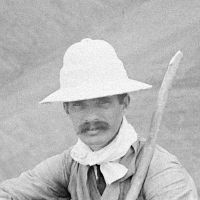
Portrait of David Binney Putnam David Binney Putnam,  David goes voyaging

“ There was a lot of pumice which is a very light stone, kind of pale gray or whitish in color. It comes from the volcanoes, like the lava. Sometimes when you step into it you sink right up to your knees. It is so light it floats on the water. It is fine for cleaning stains off your hands. [43]
At about two thirty or so they came back to the shore again and Uncle Will had such terrible cramps in his legs he could hardly stand. They said that they only went to the nearest place from which the smoke was coming.
”
Source: Gutenberg

Get perspective with Kwize: daily news enlightened by great literature