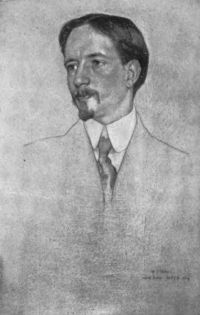
Fitz Roy Carrington

Fitz Roy Carrington

Summary

Portrait of Fitz Roy Carrington Fitz Roy Carrington Engravers and Etchers (1917)

Melancholia favors an even wider range of speculation than the Knight, Death and the Devil. This woman, who wears a laurel wreath and who, seated in gloomy meditation, supports her cheek in her left hand, while all the materials for human labor, for art, and for science lie scattered about her—does she symbolize human Reason in despair at the limits imposed upon her power? Or does the plate have a more personal and intimate meaning, reflecting Dürer’s deep grief at the death of his mother—the mother to whom he so often refers in his letters, always with heartfelt affection?
Source: Gutenberg

Portrait of Fitz Roy Carrington Fitz Roy Carrington Engravers and Etchers (1917)

Note how Rembrandt has suggested the passing of a summer thunder-storm, the rain-charged clouds rolling away to the left, while from the right the returning sunshine bathes the composition in glory, making each freshly washed leaf and blade of grass sparkle in its beams. Even the hard, slanting lines of rain in the upper left portion of the plate have their purpose, affording a needed contrast to the swiftly changing clouds, which the freshening breeze drives before it over the peopled plain and the far-reaching sea in the distance.
In 1645 there are five landscape etchings.
Source: Gutenberg

Portrait of Fitz Roy Carrington Fitz Roy Carrington Engravers and Etchers (1917)

In Adam and Eve Dürer has summed up the knowledge obtained by actual observation and by a series of drawings and studies extending over a number of years, and combined with it his theoretical working out of the proportions of the human figure, male and female. In no other plate has he lavished such loving care upon the representation of the human form. The flesh is, so to speak, caressed with the burin, as though, once and for all, the artist wished to prove to his contemporaries that the graver sufficed for the rendering of the most beautiful, the most subtle and scientific problems.
Source: Gutenberg

Get perspective with Kwize: daily news enlightened by great literature