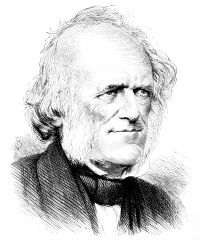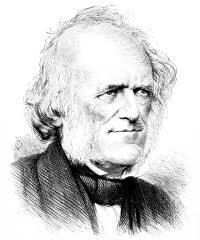
Sir Charles Lyell

Biographical details

Portrait of Sir Charles Lyell Sir Charles Lyell A Manual of Elementary Geology

No doubt the vacant space left by the missing rocks, after extensive denudation, is less imposing to the imagination than a vast thickness of conglomerate or sandstone, or the bodily presence as it were of a mountain-chain, with all its inclined and curved strata. But the denuded tracts speak a clear and emphatic language to our reason, and, like repeated layers of fossil nummulites, corals or shells, or like numerous seams of coal, each based on its under clay full of the roots of trees, still remaining in their natural position, demand an indefinite lapse of time for their elaboration.
Source: Gutenberg

Portrait of Sir Charles Lyell Sir Charles Lyell Principles of Geology

Yet many geologists, when they behold the spoils of the land heaped in successive strata, and blended confusedly with the remains of fishes, or interspersed with broken shells and corals; when they see portions of erect trunks of trees with their roots still retaining their natural position, and one tier of these preserved in a fossil state above another, imagine that they are viewing the signs of a turbulent instead of a tranquil and settled state of the planet.
Source: Gutenberg

Portrait of Sir Charles Lyell Sir Charles Lyell The Antiquity of Man

It has naturally been asked, if Man co-existed with the extinct species of the caves, why were his remains and the works of his hands never embedded outside the caves in ancient river-gravel containing the same fossil fauna? Why should it be necessary for the geologist to resort for evidence of the antiquity of our race to the dark recesses of underground vaults and tunnels which may have served as places of refuge or sepulture to a succession of human beings and wild animals, and where floods may have confounded together in one breccia the memorials of the fauna of more than one epoch?
Source: Gutenberg

Get perspective with Kwize: daily news enlightened by great literature