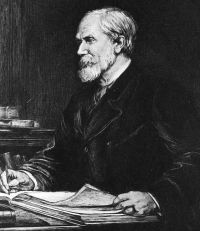
Henry Yule

Henry Yule

Summary

Portrait of Henry Yule Henry Yule Hobson-Jobson — W (1903)

WOOD-APPLE, s. [According to the Madras Gloss. also known as Curd Fruit, Monkey Fruit, and Elephant Apple, because it is like an elephant's skin.] A wild fruit of the N.O. Aurantiaceae growing in all the drier parts of India (Feronia elephantum, Correa) . It is somewhat like the bel (see BAEL) but with a still harder shell, and possesses some of its medicinal virtue. In the native pharmacopœia it is sometimes substituted (Moodeen Sherif, [Watt, Econ. Dict. iii. 324 seqq.] ) . Buchanan-Hamilton calls it the Kot-bel (Kaṭhbel) , (Eastern India, ii. 787) ] .
Source: Wikisource

Portrait of Henry Yule Henry Yule Hobson-Jobson — W (1903)

WOOTZ, s. This is an odd name which has attached itself in books to the so-called 'natural steel' of S. India, made especially in Salem, and in some parts of Mysore. It is prepared from small bits of malleable iron (made from magnetic ore) which are packed in crucibles with pieces of a particular wood (Cassia auriculata) , and covered with leaves and clay. The word first appears in a paper read before the Royal Society, June 11, 1795, called: "Experiments and observations to investigate the nature of a kind of Steel, manufactured at Bombay, and there called Wootz ...
Source: Wikisource

Portrait of Henry Yule Henry Yule Hobson-Jobson — W (1903)

It may be rendered self-evident that the figure or pattern (of Damascus steel) so long sought after exists in the cakes of Wootz, and only requires to be produced by the action of diluted acids ... it is therefore highly probable that the ancient blades (of Damascus) were made of this steel."—Wilkinson, Engines of War, pp. 203-206.
1864.—"Damascus was long celebrated for the manufacture of its sword blades, which it has been conjectured were made from the wootz of India."—Percy's Metallurgy, Iron and Steel, 860.
Source: Wikisource

Get perspective with Kwize: daily news enlightened by great literature