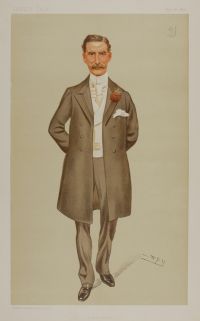
Herbert Eustace Maxwell

Herbert Eustace Maxwell

Summary

Portrait of Herbert Eustace Maxwell Herbert Eustace Maxwell Dictionary of National Biography… (1900)

As Locker-Lampson remarks: ‘This notion of the smallness of his gift may have been fostered by his never having been a really needy man: he could always afford to hunt the fox, so the excitement of the chasse aux pièces de cent sous, which stimulates most authors, was denied him.’ As it was, Whyte-Melville devoted all the earnings of his pen, which must have been considerable, to philanthropic and charitable objects, especially to the provision of reading-rooms and other recreation for grooms and stable-boys in hunting quarters.
Source: Wikisource

Portrait of Herbert Eustace Maxwell Herbert Eustace Maxwell Dictionary of National Biography… (1899)

After the queen's death (1694) he was in 1695 sent as envoy-extraordinary and plenipotentiary to the States-General; in 1697 he became one of the lords justices of Ireland, a plenipotentiary for the treaty of Ryswick, and ambassador-extraordinary at The Hague. On 13 Oct. of the same year he was created Earl of Jersey, and in 1698 he went to Paris as ambassador-extraordinary. Returning to England in 1699, he became secretary of state for the southern department on 14 May, and was one of the lords justices of England successively in 1699, 1700, and 1701.
Source: Wikisource

Portrait of Herbert Eustace Maxwell Herbert Eustace Maxwell Dictionary of National Biography… (1899)

The father, Sir Edward (1620–1689) , who was fourth son of Sir Edward Villiers (1585?–1626) [q. v.] , received knighthood on 7 April 1680, and a grant of the manor and royal house of Richmond in recognition of his services in the civil war. The mother acted as governess to the Princesses Mary and Anne (afterwards queens of England) , and her son Edward attended Princess Mary to Holland after her marriage with the Prince of Orange.
Source: Wikisource

Get perspective with Kwize: daily news enlightened by great literature