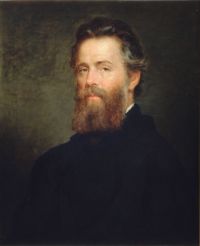
Herman Melville

Herman Melville

Summary

Portrait of Herman Melville Herman Melville The Piazza Tales, The Encantadas… (1856)

The wind was light, the waves languid; the stars twinkled with a faint effulgence; all nature seemed supine with the long night-watch, and half-suspended in jaded expectation of the sun. This was the critical hour to catch Rodondo in his perfect mood. The twilight was just enough to reveal every striking point, without tearing away the dim investiture of wonder.
From a broken, stairlike base, washed as the steps of a water palace by the waves, the tower rose in entablatures of strata to a shaven summit. These uniform layers, which compose the mass, form its most peculiar feature.
Source: Wikisource

Portrait of Herman Melville Herman Melville The Piazza Tales, The Encantadas… (1856)

All would have been bewitchingly quiescent were it not for the demoniac din created by the birds. Not only were the eaves rustling with them, but they flew densely overhead, spreading themselves into a winged and continually shifting canopy. The tower is the resort of aquatic birds for hundreds of leagues around. To the north, to the east, to the west, stretches nothing but eternal ocean; so that the man-of-war hawk coming from the coasts of North America, Polynesia, or Peru, makes his first land at Rodondo. And yet, though Rodondo be terra firma, no land bird ever lighted on it.
Source: Wikisource

Portrait of Herman Melville Herman Melville The Piazza Tales, The Encantadas… (1856)

I know not where one can better study the natural history of strange seafowl than at Rodondo. It is the aviary of Ocean. Birds light here which never touched mast or tree; hermit-birds, which ever fly alone; cloud-birds, familiar with unpierced zones of air.
Let us first glance low down to the lowermost shelf of all, which is the widest, too, and but a little space from high-water mark. What outlandish beings are these? Erect as men, but hardly as symmetrical, they stand all round the rock like sculptured caryatides, supporting the next range of eaves above.
Source: Wikisource

Get perspective with Kwize: daily news enlightened by great literature