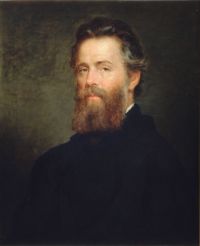
Herman Melville

Herman Melville

Summary

Portrait of Herman Melville Herman Melville Typee — Chapter 25

The voluptuous Tahitians are the only people who at all deserve to be compared with them; while the dark-haired Hawaiians and the woolly-headed Feejees are immeasurably inferior to them. The distinguishing characteristic of the Marquesan islanders, and that which at once strikes you, is the European cast of their features—a peculiarity seldom observable among other uncivilized people. Many of their faces present profiles classically beautiful, and in the valley of Typee I saw several who, like the stranger Marnoo, were in every respect models of beauty.
Source: Wikisource

Portrait of Herman Melville Herman Melville Typee — Chapter 25

When I remembered that these islanders derived no advantage from dress, but appeared in all the naked simplicity of nature, I could not avoid comparing them with the fine gentlemen and dandies who promenade such unexceptionable figures in our frequented thoroughfares. Stripped of the cunning artifices of the tailor, and standing forth in the garb of Eden—what a sorry, set of round-shouldered, spindle-shanked, crane-necked varlets would civilized men appear!
Source: Wikisource

Portrait of Herman Melville Herman Melville Typee — Chapter 25

The early period of life at which the human form arrives at maturity in this generous tropical climate, likewise deserves to be mentioned. A little creature, not more than thirteen years of age, and who in other particulars might be regarded as a mere child, is often seen nursing her own baby, whilst lads who, under less ripening skies, would be still at school, are here responsible fathers of families.
On first entering the Typee Valley, I had been struck with the marked contrast presented by its inhabitants with those of the bay I had previously left.
Source: Wikisource

Get perspective with Kwize: daily news enlightened by great literature