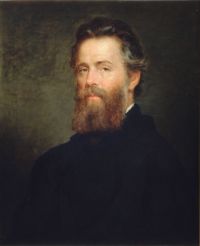
Herman Melville

Herman Melville

Summary

Portrait of Herman Melville Herman Melville White-Jacket — Chapter IV (1850)

Hence, in a crowded frigate, they are so everlastingly crossing the path of both men and officers, that in the navy it has become a proverb, that a useless fellow is "as much in the way as a reefer."
In a gale of wind, when all hands are called and the deck swarms with men, the little "middies" running about distracted and having nothing particular to do, make it up in vociferous swearing; exploding all about under foot like torpedoes. Some of them are terrible little boys, cocking their cups at alarming angles, and looking fierce as young roosters.
Source: Wikisource

Portrait of Herman Melville Herman Melville White-Jacket — Chapter IV (1850)

In some things, they almost have a harder time of it than the seamen themselves. They are messengers and errand-boys to their superiors.
"Mr. Pert," cries an officer of the deck, hailing a young gentleman forward. Mr. Pert advances, touches his hat, and remains in an attitude of deferential suspense. "Go and tell the boatswain I want him." And with this perilous errand, the middy hurries away, looking proud as a king.
The middies live by themselves in the steerage, where, nowadays, they dine off a table, spread with a cloth. They have a castor at dinner
Source: Wikisource

Portrait of Herman Melville Herman Melville White-Jacket — Chapter IV (1850)

Though these worthies sport long coats and wear the anchor-button; yet, in the estimation of the Ward-room officers, they are not, technically speaking, rated gentlemen. The First Lieutenant, Chaplain, or Surgeon, for example, would never dream of inviting them to dinner, In sea parlance, "they come in at the hawse holes;" they have hard hands; and the carpenter and sail-maker practically understand the duties which they are called upon to superintend. They mess by themselves. Invariably four in number, they never have need to play whist with a dummy.
Source: Wikisource

Get perspective with Kwize: daily news enlightened by great literature