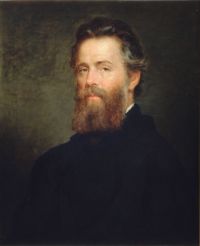
Herman Melville

Herman Melville

Summary

Portrait of Herman Melville Herman Melville White-Jacket — Chapter LXXXVII (1850)

In obedience to orders, they then paraded themselves at the mast, and, addressing the Captain, said, "Sir, our muzzle-lashings are cast off!"
Nor is it unworthy of being chronicled, that not a single sailor who complied with the general order but refused to sport the vile regulation-whiskers prescribed by the Navy Department. No! like heroes they cried, "Shave me clean! I will not wear a hair, since I cannot wear all!"
Source: Wikisource

Portrait of Herman Melville Herman Melville White-Jacket — Chapter LXXXVII (1850)

On the morrow, after breakfast, Ushant was taken out of irons, and, with the master-at-arms on one side and an armed sentry on the other, was escorted along the gun-deck and up the ladder to the main-mast. There the Captain stood, firm as before. They must have guarded the old man thus to prevent his escape to the shore, something less than a thousand miles distant at the time.
"Well, sir, will you have that beard taken off? you have slept over it a whole night now; what do you say? I don't want to flog an old man like you, Ushant!"
"My beard is my own, sir!" said the old man, lowly.
Source: Wikisource

Portrait of Herman Melville Herman Melville White-Jacket — Chapter LXXXVII (1850)

And that our man-of-war's-men were right in desiring to perpetuate their beards, as martial appurtenances, must seem very plain, when it is considered that, as the beard is the token of manhood, so, in some shape or other, has it ever been held the true badge of a warrior. Bonaparte's grenadiers were stout whiskerandoes; and perhaps, in a charge, those fierce whiskers of theirs did as much to appall the foe as the sheen of their bayonets. Most all fighting creatures sport either whiskers or beards
Source: Wikisource

Get perspective with Kwize: daily news enlightened by great literature