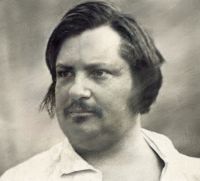
Honoré de Balzac

Honoré de Balzac

Summary

Portrait of Honoré de Balzac Honoré de Balzac Ursule Mirouët — Part I, Section 1 (1842)

For public buildings as for men, position is everything. Shaded by several trees, and thrown up by a neat square, this solitary church produced an imposing effect. In emerging on the square, the master of Nemours could see his uncle giving his arm to the young girl called Ursule, each holding a prayerbook and going into the church. The old man removed his hat in the porch, and his head, entirely white, like a snow-capped pinnacle, shone in the soft shadows of the façade.
“Well, Minoret, what do you say to your uncle’s conversion?” cried the tax-collector of Nemours, named Crémière.
Source: Wikisource

Portrait of Honoré de Balzac Honoré de Balzac Ursule Mirouët — Part I, Section 1 (1842)

In the valley of the Loing, where echoed the noises of the road, thrown back by the hill, he could hear the gallop of his own horses and the crack of his postilions’ whips. Could any but a postmaster grow impatient before a field full of Paul Potter cattle, under a Raphael sky, over a canal shaded by trees in Hobbema’s style? Anyone acquainted with Nemours knows that there nature is as beautiful as art, whose mission is to spiritualize her
Source: Wikisource

Portrait of Honoré de Balzac Honoré de Balzac Ursule Mirouët — Part I, Section 1 (1842)

This horrid fellow, called Goupil, was the head clerk of Monsieur Crémière-Dionis, the notary of Nemours. In spite of past behavior of an almost debauched lowness, Dionis had taken Goupil into his office, when further sojourn in Paris, where the clerk had dissipated the inheritance of his father, a well-to-do farmer who had destined him for a notary, was forbidden him by absolute poverty. Upon seeing Goupil, you would at once have understood that he had lost no time in enjoying life; for, to obtain enjoyment, he must have paid dearly.
Source: Wikisource

Get perspective with Kwize: daily news enlightened by great literature