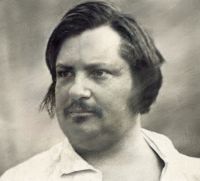
Honoré de Balzac

Honoré de Balzac

Summary

Portrait of Honoré de Balzac Honoré de Balzac Ursule Mirouët — Part II, Section 1 (1842)

So Savinien penetrated into this delicious kingdom, led away by the heart, that, to interpret itself, borrowed the power of the only art which speaks to thought by thought itself, without the help of words, color or form. Sincerity has the same power over man as childhood, it has the same charm and the same irresistible fascination; now Ursule had never been more sincere than at this moment when she was just beginning a new life.
Source: Wikisource

Portrait of Honoré de Balzac Honoré de Balzac Ursule Mirouët — Part II, Section 1 (1842)

Seated at the end of the piano, his elbow leaning upon the lid and his head in his left hand, Savinien was admiring Ursule, whose eyes, fixed upon the woodwork, seemed to be searching into a mysterious world. One might have fallen deeply in love for less. Genuine feeling has its magnetism, and Ursule wanted in some way to show her mind, as a coquette adorns herself in order to please.
Source: Wikisource

Portrait of Honoré de Balzac Honoré de Balzac Ursule Mirouët — Part II, Section 1 (1842)

Upon hearing this remark forced from this generous young man by his mother’s manners, Ursule turned pale and begged Madame de Portenduère to excuse her; she rose, took her guardian’s arm, curtsied, went out, returned home, hastily rushed into her godfather’s salon, where she sat down near the piano, buried her head in her hands and burst into tears.
“Why did you not leave the guidance of your feelings to my old experience, cruel child?” cried the doctor in despair. “The nobility never think themselves indebted to us bourgeois. By serving them, we do our duty, that is all.
Source: Wikisource

Get perspective with Kwize: daily news enlightened by great literature