Summary

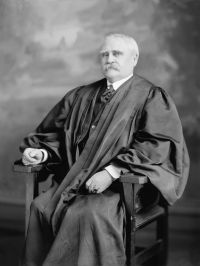
Portrait of Horace Harmon Lurton Horace Harmon Lurton Brown-Forman Company v. Kentucky…

It has been urged that the tax is not imposed as a license upon the doing of business, but is laid upon the goods produced, and is therefore arbitrary and discriminatory as one not imposed upon all other like kinds of liquor, whether produced in or out of the state. This contention, if good, would only carry the case back to the underlying objection that the classification is arbitrary and unreasonable, and therefore void, as denying the equal protection of the law,-a question which at last must be answered, whether the tax be an occupation or a property tax.
Source: Wikisource

Portrait of Horace Harmon Lurton Horace Harmon Lurton Brown-Forman Company v. Kentucky…

Under the statute, a man may not legally engage in the business without giving the notice and having the certificate from the auditor. The payment of the tax at the times required by the statute is the condition upon which authority to continue in the business is made to depend. This is manifestly a tax on the business, and not upon the property. The amount of the tax is simply regulated by the amount of the product, but it is a license tax upon the business.
Source: Wikisource

Portrait of Horace Harmon Lurton Horace Harmon Lurton Brown-Forman Company v. Kentucky…

Manifestly there is nothing capricious in putting the occupation carried on by the plaintiff in error in a class distinct from that of the whisky distillers whose straight product is the basis for the manipulated product of those engaged in the taxed business. A very wide discretion must be conceded to the legislative power of the state in the classification of trades, callings, businesses, or occupations which may be subjected to special forms of regulation or taxation through an excise or license tax.
Source: Wikisource

Get perspective with Kwize: daily news enlightened by great literature