Summary

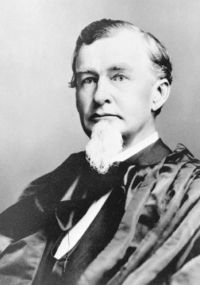
Portrait of Howell Edmunds Jackson Howell Edmunds Jackson Merchants' Cotton-Press Storage Company v…

The compress company had therefore no personal interest whatever in the fire insurance policies, as against the railroad company, by virtue of the contract between the railroad company and the compress company, and by the terms of the fire insurance policies the railroad company was the beneficiary under those policies to the extent necessary to indemnify it against liability for losses incurred directly to itself, or through its liability on its bills of lading.
Source: Wikisource

Portrait of Howell Edmunds Jackson Howell Edmunds Jackson Merchants' Cotton-Press Storage Company v…

It is further shown by the pleadings that the Phenix Insurance Company, in its cross bill, made a defendant of the Newport News & Mississippi Valley Company, a corporation organized under the laws of Connecticut, which was a carrier from Memphis to points east, and had a contract with the compress company, like that of the Cairo, Vincennes & Chicago Railroad Company, to insure cotton to be carried over its line, under which arrangement it had issued bills of lading to various parties insured by the Phenix Insurance Company
Source: Wikisource

Portrait of Howell Edmunds Jackson Howell Edmunds Jackson Merchants' Cotton-Press Storage Company v…

Anthony J. Thomas and Charles E. Tracy, as receiver thereof, citizens of New York; the Merchants' Cotton-Press & Storage Company, a corporation, of Tennessee; S. R. Montgomery, Napoleon Hill, and Thomas H. Allen, Jr., as trustees, citizens of Tennessee, together with six other alien marine insurance companies, and William Watson and E. R. Wood, aliens, and 44 fire insurance companies of West Virginia, Pennsylvania, New York, Illinois, Louisiana, Wisconsin, Alabama, Connecticut, Ohio, Texas, Indiana, and of the United Kingdom of Great Britain and Ireland.
Source: Wikisource

Get perspective with Kwize: daily news enlightened by great literature