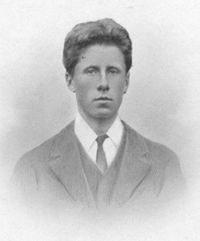
Hugh Lofting

Hugh Lofting

Summary

Portrait of Hugh Lofting Hugh Lofting Doctor Dolittle in the Moon (1928)

I have never known a time when it was harder to shake loose the feeling of living in a dream as those first few hours we spent on the Moon. The knowledge that we were treading a new world never before visited by Man, added to this extraordinary feeling caused by the gravity, of lightness, of walking on air, made you want every minute to have some one tell you that you were actually awake and in your right senses. For this reason I kept constantly speaking to the Doctor or Chee-Chee or Polynesia—even when I had nothing particular to say.
Source: Gutenberg

Portrait of Hugh Lofting Hugh Lofting Doctor Dolittle in the Moon (1928)

Our bones might to-day be mouldering in the sands of the Moon if it had not been for your un-taught science, your jungle skill—and, above all, your courage that overcame your fear!
Well, to return: as I ate these strange fruits and sipped the water that brought life back I gazed upward and saw before me a sort of ridge. On its level top a vegetation, a kind of tangled forest, flourished; and trailing down from this ridge were little outposts of the Vegetable Kingdom, groups of bushes and single trees, that scattered and dribbled away in several directions from the main mass.
Source: Gutenberg

Portrait of Hugh Lofting Hugh Lofting Doctor Dolittle in the Moon (1928)

Human attention is like butter: you can only spread it so thin and no thinner. If you try to spread it over too many things at once you just don’t remember them. And certainly during all our waking hours upon the Moon there was so much for our ears and eyes and minds to take in it is a wonder, I often think, that any clear memories at all remain.
The one who could have been of most help to me in writing my impressions of the Moon was Jamaro Bumblelily, the giant moth who carried us there.
Source: Gutenberg

Get perspective with Kwize: daily news enlightened by great literature