Summary

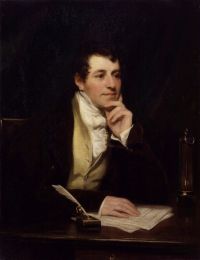
Portrait of Humphry Davy Humphry Davy Proceedings of the Royal Society of London (1833)

Beside the use which may be made of what remains of ancient paintings as models for imitation, the author has endeavoured to reap the further advantage of making us acquainted with the nature and chemical composition of their colours; for though the works of Dioscorides, Vitruvius, and Pliny contain descriptions of many substances used by the ancients as pigments, it is only by experiment that the subjects of which they speak can be identified.
Source: Wikisource

Portrait of Humphry Davy Humphry Davy Proceedings of the Royal Society of London (1833)

When a cylinder of wire gauze, covered at top with the same gauze, is closely fitted to a lamp, and surrounds its flame so that there is no aperture but those of the gauze, if the little lantern so constructed be introduced into the most explosive mixtures of carburetted hydrogen and air, the cylinder becomes filled with a bright flame at its interior surface, which continues to burn as long as the mixture remains explosive.
Source: Wikisource

Portrait of Humphry Davy Humphry Davy Proceedings of the Royal Society of London (1833)

As the heat rises, an elastic fluid is emitted of a bright yellowish green colour. This gas may be received over mercury, on which it has no action; but it is rapidly absorbed by water. Its smell is aromatic, without any smell of chlorine. It destroys vegetable blues, without previously reddening them. By a temperature of 212° it explodes with more violence than euchlorine, expanding more, and producing more light.
Source: Wikisource

Get perspective with Kwize: daily news enlightened by great literature