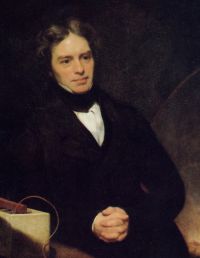
Michael Faraday

Michael Faraday

Summary

Portrait of Michael Faraday Michael Faraday The Liquefaction of Gases (1896)

Carbonic acid.—The solidification of carbonic acid by M. Thilorier is one of the most beautiful experimental results of modern times. He obtained the substance, as is well known, in the form of a concrete white mass like fine snow, aggregated. When it is melted and resolidified by a bath of low temperature, it then appears as a clear, transparent, crystalline, colourless body, like ice; so clear, indeed, that at times it was doubtful to the eye whether anything was in the tube, yet at the same time the part was filled with solid carbonic acid.
Source: Wikisource

Portrait of Michael Faraday Michael Faraday The Liquefaction of Gases (1896)

I now proceeded to the muriatic acid gas, and upon the condensation of a small quantity of it, a beautiful green coloured substance adhered to the side of the receiver, which had all the qualities of muriatic acid; but upon a large quantity, four pints, being condensed, the result was a yellowish-green glutinous substance, which does not evaporate, but is instantly absorbed by a few drops of water; it is of a highly pungent quality, being the essence of muriatic acid. As this gas easily becomes fluid, there is little or no elasticity, so that any quantity may be condensed without danger.
Source: Wikisource

Portrait of Michael Faraday Michael Faraday The Liquefaction of Gases (1896)

There is no reason for believing that oil gas, or olefiant gas, has, as yet, been condensed into a liquid, or that it will take that form at common temperatures under a pressure of five, or ten, or even twenty atmospheres. If it were possible, a small, safe, and portable gas lamp would immediately offer itself to us, which might be filled with liquid without being subject to any greater force than the strength of its vapour, and would afford an abundant supply of gas as long as any of the liquid remained.
Source: Wikisource

Get perspective with Kwize: daily news enlightened by great literature