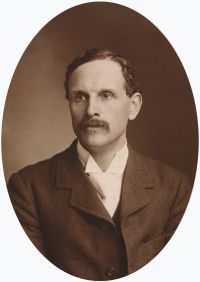
Hugh Longbourne Callendar

Hugh Longbourne Callendar

Summary

Portrait of Hugh Longbourne Callendar Hugh Longbourne Callendar 1911 Encyclopædia Britannica, Volume 27… (1911)

It is a matter of common experience that evaporation is accelerated by currents of air, or by the use of an exhaust pump, or by any process which removes the vapour rapidly from the liquid. On the other hand, it is retarded, and finally ceases, if the vapour is allowed to accumulate in a closed space. When this equilibrium state is reached, the space is said to be saturated with the vapour; the density of the vapour is then the maximum which can exist in the presence of the liquid at the temperature of the experiment, and its pressure is called the saturation-pressure.
Source: Wikisource

Portrait of Hugh Longbourne Callendar Hugh Longbourne Callendar 1911 Encyclopædia Britannica, Volume 27… (1911)

Total Heat and Latent Heat.—To effect the conversion of a solid or liquid into a vapour without change of temperature, it is necessary to supply a certain quantity of heat. The quantity required per unit mass of the substance is termed the latent heat of vaporization. The total heat of the saturated vapour at any temperature is usually defined as the quantity of heat required to raise unit mass of the liquid from any convenient zero up to the temperature considered, and then to evaporate it at that temperature under the constant pressure of saturation.
Source: Wikisource

Portrait of Hugh Longbourne Callendar Hugh Longbourne Callendar 1911 Encyclopædia Britannica, Volume 27… (1911)

A bubble of vapour containing no air or gas could not exist at all in stable equilibrium in a liquid. If its radius r were such as to make 2T/r greater than p−P, it would collapse entirely. A bubble containing gas, on the contrary, is in stable equilibrium when its radius r is such that the pressure of the gas and vapour inside it balance the external pressure P together with the capillary pressure 2T/r. Any diminution of r produces an increase in the pressure of the gas which is more than sufficient to balance the increase of the capillary pressure 2T/r.
Source: Wikisource

Get perspective with Kwize: daily news enlightened by great literature