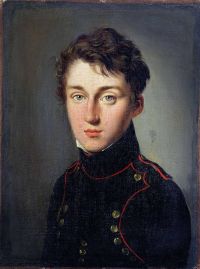
Nicolas Léonard Sadi Carnot

Nicolas Léonard Sadi Carnot

Summary

Portrait of Nicolas Léonard Sadi Carnot Nicolas Léonard Sadi Carnot Reflections on the Motive Power of Heat (1897)

It is this man who has probably inaugurated the development of the modern science of thermodynamics and the whole range of sciences dependent upon it, and who has thus made it possible to construct a science of the energetics of the universe, and to read the mysteries of every physical phenomenon of nature; it is this man who has done more than any contemporary in his field, and who thus displayed a more brilliant genius than any man of science of the nineteenth century: yet not even his name appears in the biographical dictionaries
Source: Wikisource

Portrait of Nicolas Léonard Sadi Carnot Nicolas Léonard Sadi Carnot Reflections on the Motive Power of Heat (1897)

From that time the additional progress so rapidly made in the new science was as inevitable as the development of a gold-field, once the precious metal has been found in paying quantities in the hitherto unvisited cañons and gorges of a distant and unexplored mountain-range. But great as is the work since done, and great as have been the discoveries and the discoverers of later years, none claims our gratitude and compels our respect in greater degree than does the original discoverer—
Sadi Carnot.
Source: Wikisource

Portrait of Nicolas Léonard Sadi Carnot Nicolas Léonard Sadi Carnot Reflections on the Motive Power of Heat (1897)

On the one hand it was held by the best-known physicists that heat is a substance which pervades all bodies in greater or less amount, and that heating and cooling are simply the absorption and the rejection of this “imponderable substance” by the body affected; while, on the other hand, it was asserted by a small but increasing number that heat is a “mode of motion,” a form of energy, not only imponderable, but actually immaterial; a quality of bodies, not a substance, and that it is identical, in its nature, with other forms of recognizable energy, as, for example, mechanical energy.
Source: Wikisource

Get perspective with Kwize: daily news enlightened by great literature