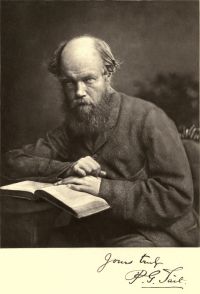
Peter Guthrie Tait

Peter Guthrie Tait

Summary

Portrait of Peter Guthrie Tait Peter Guthrie Tait Encyclopædia Britannica, Ninth Edition (1888)

But the law of electric repulsion shows us at once that, as soon as the drops in a cloud are sufficiently electrified, at least the greater part of their charge must pass to the boundary of the cloud. When this occurs, the nature of the further behaviour of the charge presents no difficulty. The reason for our singularly complete ignorance of the source of atmospheric electricity seems to lie in the fact that it can only be discovered by means of experiments made on a scale very much larger than is attainable with the ordinary resources of a laboratory.
Source: Wikisource

Portrait of Peter Guthrie Tait Peter Guthrie Tait Encyclopædia Britannica, Ninth Edition (1888)

And now we have Carnot's invaluable proposition, a reversible heat-engine is a perfect engine, perfect, that is, in the sense that no other heat-engine can be superior to it. Before giving the proof, let us see the immense con sequences of this proposition. Reversibility is the sole test of perfection; so that all heat-engines, whatever be the working substance, provided only they be reversible, convert into work (under given circumstances) the same fraction of the heat supplied to them. The only circumstances involved are the temperatures of the source and condenser.
Source: Wikisource

Portrait of Peter Guthrie Tait Peter Guthrie Tait Encyclopædia Britannica, Ninth Edition (1888)

We have now to consider that, if an engine (whether simple or compound) does work at all by means of heat, less heat necessarily reaches the condenser than left the boiler. Hence, if there be two engines A and B as before, and the joint system be worked in such a way that B constantly restores to the source the heat taken from it by A, we can account for the excess of work done by A over that spent on B solely by supposing that B takes more heat from the condenser than A gives to it. Such a compound engine would transform into work heat taken solely from the condenser.
Source: Wikisource

Get perspective with Kwize: daily news enlightened by great literature