Thermometer

Definition and stakes

Various,  Philosophical transactions, Vol…

“ THE thermometer (Tab. XI. fig. 1.) is designed for shewing the greatest degree of heat, which happens in any place during the absence of the observer. It consists of a cylinder of glass joined to a tube, and differs from common thermometers only in having the top of the stem drawn out into a capillary tube, which enters into a glass ball C, joined on to the stem at the place where it begins to be contracted. The cylinder, and part of the tube, are filled with mercury; the top of which shews the common degrees of heat as usual. ”
Source: Gutenberg

N. Hawkins,  Pumps and Hydraulics, Part 2 (of 2…

“ The Thermometer is an instrument to indicate the temperature of the atmosphere. It is constructed on the principle that heat expands and cold contracts most substances. The thermometer consists of a capillary tube, closed at the top and terminating downwards in a bulb. It is filled with mercury which expands and fills the whole length of the tube or contracts altogether into the bulb, according to the degree of heat or cold to which it is exposed. Any other fluid which is expanded19 by heat and contracted by cold, may be used instead of mercury. ”
Source: Gutenberg

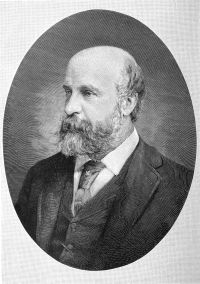
Portrait of Henry Carrington Bolton Henry Carrington Bolton,  Evolution of the Thermometer (1900)

“ It would be well to have a universal and determinate standard for heat and cold, securing a definite proportion between the capacity of the bulb and the tube, and then taking for the commencement the degree of cold at which water begins to freeze, or better the temperature of boiling water, so that without sending a thermometer to a distance, one could communicate the degrees of heat or of cold found in experiments and record them for the use of posterity. ”
Source: Wikisource

Get perspective with Kwize: daily news enlightened by great literature