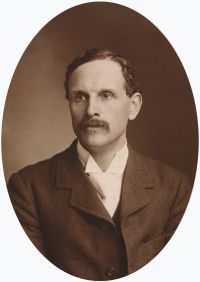
Hugh Longbourne Callendar

Hugh Longbourne Callendar

Summary

Portrait of Hugh Longbourne Callendar Hugh Longbourne Callendar 1911 Encyclopædia Britannica (1911)

It is a matter of common observation that rays of the sun or of a fire falling on a body warm it, and it was in the first instance natural to suppose that heat itself somehow travelled across the intervening space from the sun or fire to the body warmed, in much the same way as heat may be carried by a current of hot air or water. But we now know that energy of radiation is not the same thing as heat, though it is converted into heat when the rays strike an absorbing substance.
Source: Wikisource

Portrait of Hugh Longbourne Callendar Hugh Longbourne Callendar 1911 Encyclopædia Britannica (1911)

If there is equilibrium both mechanical and thermal at every stage of the cycle, the ideal engine will be perfectly reversible. That is to say, all its operations will be exactly reversed as regards transfer of heat and work, when the operations are performed in the reverse order and direction. On this understanding Carnot’s principle may be put in a different way, which is often adopted, but is really only the same thing put in different words: The efficiency of a perfectly reversible engine is the maximum possible, and is a function solely of the limits of temperature between which it works.
Source: Wikisource

Portrait of Hugh Longbourne Callendar Hugh Longbourne Callendar 1911 Encyclopædia Britannica (1911)

Without difference of temperature there is no transfer of heat. When two bodies have been brought to the same temperature by conduction, they are also in equilibrium as regards radiation, and vice versa. If this were not the case, there could be no equilibrium of heat defined by equality of temperature. A hot body placed in an enclosure of lower temperature, e.g. a calorimeter in its containing vessel, generally loses heat by all three modes simultaneously in different degrees.
Source: Wikisource

Get perspective with Kwize: daily news enlightened by great literature