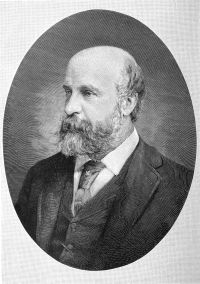
Henry Carrington Bolton

Henry Carrington Bolton

Summary

Portrait of Henry Carrington Bolton Henry Carrington Bolton Evolution of the Thermometer (1900)

Newton made no use of the boiling-point of water in constructing his scale of temperatures, as he considered it variable; he recorded that water begins to boil at 33° of his scale, and boils vehemently at 34° to 341⁄2°. We now know that such fluctuations depend upon the position of the thermometer (which must not be immersed in the liquid) , on the pressure of the atmosphere, on the chemical purity of the water, and on the shape of the vessel holding it, so it is not surprising that doubts existed as to the constancy of the phenomenon.
Source: Wikisource

Portrait of Henry Carrington Bolton Henry Carrington Bolton Evolution of the Thermometer (1900)

Also one can determine how much colder one day is than another, noting how many degrees the water ascends and descends. One can compare the greatest heat and cold of one year with those of another year. One can ascertain how much hotter one room is than another; one can maintain a room at an equal temperature by making the water of the thermometer stand always at a certain degree. One can test also the intensity of fevers; in short, one can know pretty nearly to what extent air is rarefied in the greatest heat, and so forth.
Source: Wikisource

Portrait of Henry Carrington Bolton Henry Carrington Bolton Evolution of the Thermometer (1900)

At that date, and in the eightieth year of his age, he published a work on natural philosophy, in which he suggested taking the melting-point of ice and the boiling-point of water for two fixed points of thermometer scales, and dividing the space between them into twelve equal parts. This truly admirable proposition was not appreciated by his contemporaries who did not wholly believe in the constancy of these temperatures, and it was forgotten by succeeding philosophers, thus delaying greatly accurate observations of temperature.
Source: Wikisource

Get perspective with Kwize: daily news enlightened by great literature