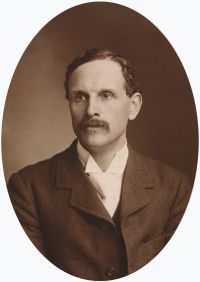
 Hugh Longbourne Callendar,
1911 Encyclopædia Britannica
(1911)
Hugh Longbourne Callendar,
1911 Encyclopædia Britannica
(1911)
“ Corresponding to each crystalline hydrate there is generally a separate branch of the solubility curve along which the crystals of the hydrate are in equilibrium with the saturated solution. At any given temperature the hydrate possessing the least solubility is the most stable. If two are present in contact with the same solution, the more soluble will dissolve, and the less soluble will be formed at its expense until the conversion is complete. The two hydrates cannot be in equilibrium with the same solution except at the temperature at which their solubilities are equal, i.e. ”