Summary

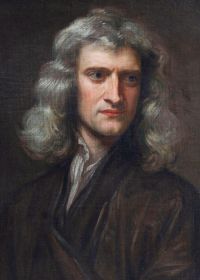
Portrait of Isaac Newton Isaac Newton The Mathematical Principles of Natural Philosophy…

If there be several bodies consisting of equal particles whose forces are as the distance of the places from each; the force compounded of all the forces by which any corpuscle is attracted, will tend to the common centre of gravity of the attracting bodies; and will be the same as if those attracting bodies, preserving their common centre of gravity, should unite there, and be formed into a globe.
Source: Wikisource

Portrait of Isaac Newton Isaac Newton The Mathematical Principles of Natural Philosophy…

And hence if an finite body, plane on one side, attract a corpuscle situate over-against the middle of that plane, and the distance between the corpuscle and the plane compared with the dimensions of the attracting body be extremely small; and the attracting body consist of homogeneous particles, whose attractive forces decrease in the ratio of any power of the distances greater than the quadruplicate; the attractive force of the whole body will decrease very nearly in the ratio of a power whose side is that very small distance, and the index less by 3 than the index of the former power.
Source: Wikisource

Portrait of Isaac Newton Isaac Newton The Mathematical Principles of Natural Philosophy…

For if the bodies are divided into particles proportional to the wholes and alike situated in them, it will be, as the attraction towards any particle of one of the bodies to the attraction towards the correspondent particle in the other body, so are the attractions towards the several particles of the first body to the attractions towards the several correspondent particles of the other body; and by composition, so is the attraction towards the first whole body to the attraction towards the second whole body.
Source: Wikisource

Get perspective with Kwize: daily news enlightened by great literature