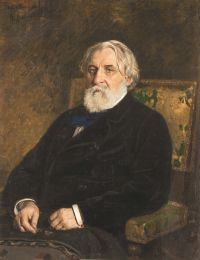
Ivan Turgenev

Ivan Turgenev

Summary

Portrait of Ivan Turgenev Ivan Turgenev The Jew and Other Stories (1899)

The novel modelled by Turgenev's hands, the Russian novel, became the great modern instrument for showing 'the very age and body of the time his form and pressure.' To reproduce human life in all its subtlety as it moves and breathes before us, and at the same time to assess its values by the great poetic insight that reveals man's relations to the universe around him,—that is an art only transcended by Shakespeare's own in its unique creation of a universe of great human types.
Source: Wikisource

Portrait of Ivan Turgenev Ivan Turgenev The Jew and Other Stories (1899)

In England alone, perhaps, is it necessary to say to the young novelist that the novel can become anything, can be anything, according to the hands that use it. In its application to life, its future development can by no means be gauged. It is the most complex of all literary instruments, the chief method to-day of analysing the complexities of modern life. If you love your art, if you would exalt it, treat it absolutely seriously. If you would study it in its highest form, the form the greatest artist of our time has perfected—remember Turgenev.
Source: Wikisource

Portrait of Ivan Turgenev Ivan Turgenev The Jew and Other Stories (1899)

Many men of letters to-day look on the novel as a mere story-book, as a series of light-coloured, amusing pictures for their 'idle hours,' and on memoirs, biographies, histories, criticism, and poetry as the age's serious contribution to literature. Whereas the reverse is the case. The most serious and significant of all literary forms the modern world has evolved is the novel; and brought to its highest development, the novel shares with poetry to-day the honour of being the supreme instrument of the great artist's literary skill.
Source: Wikisource

Get perspective with Kwize: daily news enlightened by great literature