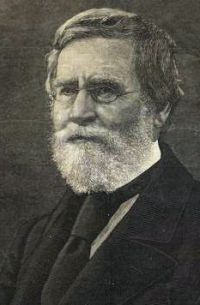
Jacob Abbott

Jacob Abbott

Summary

Portrait of Jacob Abbott Jacob Abbott Forests of Maine

If there is just as much of the wood or ice above the water as is equal to the bulk of the man, then the man, in stepping upon it, will sink it just to the water's edge."
"But perhaps one man would be heavier than another man," said Marco.
"Yes," replied Forester; "but then he would be larger, and so, according to the principle, he would make more wood sink before the equilibrium was reached."
"What is equilibrium?" asked Marco.
"Equilibrium is an equality between two forces," replied Forester.
Source: Gutenberg

Portrait of Jacob Abbott Jacob Abbott Forests of Maine

Another is, its color."
"What color is it?" asked Marco.
"Black," replied Forester,—"black as jet; at least, one kind is black as jet. There is a kind which is brown. It is called brown ebony."
"I don't think black is very pretty," said Marco.
"No," said Forester; "there does not seem to be much beauty in black, in itself considered; but then, for certain purposes, it is much handsomer than any other color would be; for a cane, for instance."
Marco looked at the beech cane which he had before him, and began to consider how it would look if it were black.
Source: Gutenberg

Portrait of Jacob Abbott Jacob Abbott Forests of Maine

CHAPTER VI. EBONY AND PINE.
After riding along a short distance in silence, Marco introduced the subject of the different woods once more. He asked Forester which was the most costly of all the woods.
"Costly is not an ambiguous term," said Forester; "that means, which has the greatest money value."
"Yes," said Marco. "I suppose it is mahogany."
"O no," said Forester.
"Rose wood, then," said Marco. "It must be rose wood. My mother has a beautiful piano made of rose wood."
"No," said Forester. "Ebony is more costly than either rose wood or mahogany. They sell ebony by the pound."
Source: Gutenberg

Get perspective with Kwize: daily news enlightened by great literature