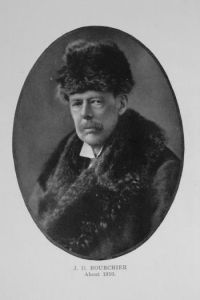
James David Bourchier

James David Bourchier

Summary

Portrait of James David Bourchier James David Bourchier 1911 Encyclopædia Britannica, Volume 4… (1911)

Language.—The Bulgarian is at once the most ancient and the most modern of the languages which constitute the Slavonic group. In its groundwork it presents the nearest approach to the old ecclesiastical Slavonic, the liturgical language common to all the Orthodox Slavs, but it has undergone more important modifications than any of the sister dialects in the simplification of its grammatical forms
Source: Wikisource

Portrait of James David Bourchier James David Bourchier 1911 Encyclopædia Britannica, Volume 4… (1911)

With the exception of Zlatarski’s and Boncheff’s geological treatises and contributions by Georgieff, Petkoff, Tosheff and Urumoff to Velnovski’s Flora Bulgarica, no original works on natural science have as yet been produced; a like dearth is apparent in the fields of philosophy, criticism and fine art, but it must be remembered that the literature is still in its infancy. The ancient folk-songs have been preserved in several valuable collections; though inferior to the Servian in poetic merit, they deserve scientific attention.
Source: Wikisource

Portrait of James David Bourchier James David Bourchier 1911 Encyclopædia Britannica, Volume 4… (1911)

The literary language began in the western dialect under the twofold influence of Servian literature and the Church Slavonic. In a short time, however, the eastern dialect prevailed, and the influence of Russian literature became predominant. An anti-Russian reaction was initiated by Borgoroff (1818–1892) , and has been maintained by numerous writers educated in the German and Austrian universities. Since the foundation of the university of Sofia the literary language has taken a middle course between the ultra-Russian models of the past generation and the dialectic Bulgarian.
Source: Wikisource

Get perspective with Kwize: daily news enlightened by great literature