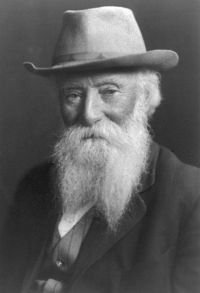
John Burroughs

John Burroughs

Summary

Portrait of John Burroughs John Burroughs Ways of Nature

All this is a very human way of looking at the matter, and is typical of the way we all—most of us—speak of the lower animals, defining them to ourselves in terms of our own mentality, but it leads to false notions about them. We look upon an animal fretting and struggling in its cage as longing for freedom, picturing to itself the joy of the open air and the free hills and sky, when the truth of the matter undoubtedly is that the fluttering bird or restless fox or lion simply feels discomfort in confinement.
Source: Gutenberg

Portrait of John Burroughs John Burroughs Ways of Nature

The songless birds—why has Nature denied them this gift? But they nearly all have some musical call or impulse that serves them very well. The quail has his whistle, the woodpecker his drum, the pewee his plaintive cry, the chickadee his exquisitely sweet call, the highhole his long, repeated "wick, wick, wick," one of the most welcome sounds of spring, the jay his musical gurgle, the hawk his scream, the crow his sturdy caw. Only one of our pretty birds of the orchard is reduced to an all but inaudible note, and that is the cedar-bird.
Source: Gutenberg

Portrait of John Burroughs John Burroughs Ways of Nature

Strictly speaking, he is not capable of conceptions at all, but only of sense impressions; his sure guide is instinct—not blundering reason. The dog starts with a fund of knowledge, which man acquires slowly and painfully. But all this does not trouble one in reading of Maeterlinck's dog. Our interest is awakened, and our sympathies are moved, by seeing the world presented to the dog as it presents itself to us, or by putting ourselves in the dog's place. It is not false natural history, it is a fund of true human sentiment awakened by the contemplation of the dog's life and character.
Source: Gutenberg

Get perspective with Kwize: daily news enlightened by great literature