Summary

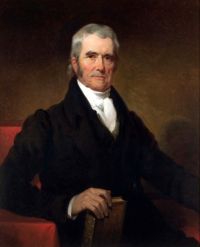
Portrait of John Marshall John Marshall Reynolds v. McArthur — Opinion of the Court

The instructions to the jury, for which the plaintiff applied to the state court, are some of them mixed questions, involving fact with law, and requiring the court to decide the fact, and then to declare the law upon that fact. Others propose a rule, as of universal application, to ascertain the main branch of a river, and the source of that main branch, which would unquestionably, in many cases, mislead us. They propose one single circumstance, in exclusion of all others, as being the infallible evidence of a complex fact depending on a number of varying circumstances.
Source: Wikisource

Portrait of John Marshall John Marshall Reynolds v. McArthur — Opinion of the Court

When France ceded to Great Britain all her pretensions to the country lying east of the Mississippi, 'from its source to the river Iberville,' no man could have been so extravagant as to assert, that the source of the Mississippi was to be looked for through all its branches, and fixed at that point in the channel of either in which water might be found farthest removed from the mouth of the river.
Source: Wikisource

Portrait of John Marshall John Marshall Reynolds v. McArthur — Opinion of the Court

It is a principle which has always been held sacred in the United States, that laws by which human action is to be regulated, look forwards, not backwards; and are never to be construed retrospectively unless the language of the act shall render such construction indispensable. No words are found in the act of 1818 which render this odious construction indispensable. The language is that Ludlow's line shall be considered and held, that is, shall in future be considered and held as the true western boundary of that reserve.
Source: Wikisource

Get perspective with Kwize: daily news enlightened by great literature