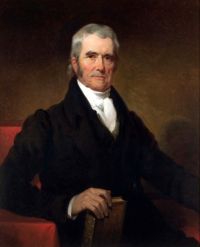
Summary

Portrait of John Marshall John Marshall Simms v. Guthrie — Opinion of the Court

If the land, when improved, was waste and unappropriated, if, at the passage of the act, no other person had 'any legal right or claim' to the land so improved, such right could not be acquired until that of the improver should be lost.
The second error is, that the entry made by Terrell and Hawkins with the surveyor has no reference to the pre-emption certificate of Ash, and is therefore not a good and valid entry of Ash's pre-emption right.
Source: Wikisource

Portrait of John Marshall John Marshall Simms v. Guthrie — Opinion of the Court

It is also objected that some of the Defendants in error do not show a complete legal title under Terrell and Hawkins, for which reason they have not entitled themselves to a conveyance from Charles Simms; and that one of them, John Meiggs, has obtained a decree for 140 acres of land, although in the bill he claimed only 100 acres.
Regularly the Claimants who have only an equitable title ought to make those whose title they assert, as well as the person from whom they claim a conveyance, parties to the suit.
Source: Wikisource

Portrait of John Marshall John Marshall Simms v. Guthrie — Opinion of the Court

On coming to the place, Ash's improvement would have been found. The mistake, therefore, does not mislead subsequent locators. It does not point to a different place. They are as well informad as they would have been by the insertion of the omitted words. The entry, too, contains a reference to the warrant which the law directed to be lodged with the surveyor, and to remain there until it should be returned with the plat and certificate of survey to the land office.
Source: Wikisource

Get perspective with Kwize: daily news enlightened by great literature