Summary

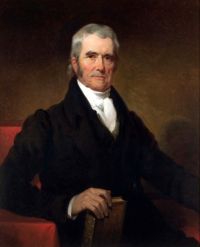
Portrait of John Marshall John Marshall The President and Directors of the Bank of Washington v…

Had the Bank taken no step whatever to obtain an acceptance, no violation of duty would, according to these decisions, have been committed.-Can any unsuccessful attempt to do that which the law does not require, place the agent in the same situation that he would have stood in, had the drawee been found, and had positively refused acceptance? Absence from home, with a failure to make provision for payment when a bill becomes due, is a failure to pay; but absence from home when the holder of a bill or his agent offers it for acceptance, is in no respect culpable.
Source: Wikisource

Portrait of John Marshall John Marshall The President and Directors of the Bank of Washington v…

That bank would, of course, become the agent of the holder. By transmitting the bill, as directed, the Mechanics Bank performed its duty, and the whole responsibility of collection devolved on the bank which received the bill for that purpose; the Mechanics Bank was the mere channel through which Triplett & Neale transmitted the bill to the Bank of Washington.
The deposit of a bill in one bank, to be transmitted for collection, to another, is a common usage of great public convenience, the effect of which is well understood.
Source: Wikisource

Portrait of John Marshall John Marshall The President and Directors of the Bank of Washington v…

The allowance of days of grace, is a usage, which pervades the whole commercial world. It is now universally understood to enter into every bill, or note, of a mercantile character, and to form so completely a part of the contract, that the bill does not become due, in fact, or in law, on the day mentioned on its face, but on the last day of grace. A demand of payment, previous to that day, will not authorize a protest, or charge the drawer of the bill.
Source: Wikisource

Get perspective with Kwize: daily news enlightened by great literature