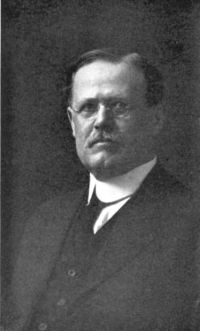
John Merle Coulter

John Merle Coulter

Summary

Portrait of John Merle Coulter John Merle Coulter,  Popular Science Monthly (1912)

“ Several things have contributed to the completeness of this knowledge of Gymnosperms. They have always been abundant in the flora of every period that has left a plant record, and they are still abundant. This has given continuity and wealth of material throughout the whole history of vegetation, so far as that history is known. Those who picture an historical succession of the great plant groups are not representing the records in sight, for our earliest records show a vegetation as varied and complex as that of to-day, so far as the great groups are concerned. ”
Source: Wikisource

Portrait of John Merle Coulter John Merle Coulter,  Popular Science Monthly (1912)

“ NO great group of plants seems to have left so continuous and full a record of itself, through so long a stretch of time, as have the Gymnosperms. Further work may uncover equally extensive records of certain other vascular groups, but our knowledge of the history of Gymnosperms is at present more complete than that of any other group of plants. ”
Source: Wikisource

Portrait of John Merle Coulter John Merle Coulter,  Popular Science Monthly (1912)

“ The external appearance of Bennettitales justifies their early assignment to the Cycads, for the whole habit is Cycadean. The stems are either tuberous or cylindrical, and crowned by a rosette of large, fern-like leaves, giving to the cylindrical forms the appearance of tree ferns. The remarkable feature of Bennettitales, however, is the cone (strobilus) , whose structure is unique among Gymnosperms. These cones, instead of being solitary and terminal, in the midst of the rosette of leaves, as in most Cycads, are lateral on dwarf branches which arise in profusion from the stem. ”
Source: Wikisource

Get perspective with Kwize: daily news enlightened by great literature