Summary

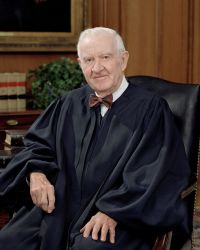
Portrait of John Paul Stevens John Paul Stevens Perpich v. Department of Defense…

Lexicographers and others define militia, and so the common understanding is, to be 'a body of armed citizens trained to military duty, who may be called out in certain cases, but may not be kept on service like standing armies, in time of peace.' That is the case as to the active militia of this State. The men comprising it come from the body of the militia, and when not engaged at stated periods in drilling and other exercises, they return to their usual avocations, as is usual with militia, and are subject to call when the public exigencies demand it.
Source: Wikisource

Portrait of John Paul Stevens John Paul Stevens Perpich v. Department of Defense…

The subordinate authority to perform the actual training prior to active duty in the federal service does not include the right to edit the discipline that Congress may prescribe for Guard members after they are ordered into federal service.
The Governor argues that this interpretation of the Militia Clauses has the practical effect of nullifying an important state power that is expressly reserved in the Constitution. We disagree. It merely recognizes the supremacy of federal power in the area of military affairs.
Source: Wikisource

Portrait of John Paul Stevens John Paul Stevens Perpich v. Department of Defense…

It is by congressional choice that the available pool of citizens has been formed into organized units. Over the years, Congress has exercised this power in various ways, but its current choice of a dual enlistment system is just as permissible as the 1792 choice to have the members of the militia arm themselves. Second, the Clause authorizes Congress to provide for governing such part of the militia as may be employed in the service of the United States. Surely this authority encompasses continued training while on active duty.
Source: Wikisource

Get perspective with Kwize: daily news enlightened by great literature