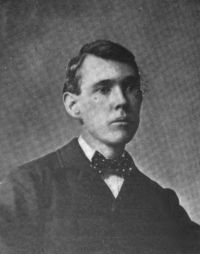
John T. McIntyre

John T. McIntyre

Summary

Portrait of John T. McIntyre John T. McIntyre The Young Continentals at Trenton (1911)

During the entire fight, George’s great dread was that the fire might die out through want of attention. He did not fear Slade, or the outcome of the struggle; but that the waiting Americans upon the west bank might misread his signal gave him much anxiety. Even in the midst of the battling, he managed to keep his attention on the fire. Instead of dying out it grew stronger and stronger; indeed, it roared and sparkled bravely in the wind; its light made the hillside as plain as day. Amazed at this, George finally managed to twist about so in Slade’s clutch that he got a good view of the fire.
Source: Gutenberg

Portrait of John T. McIntyre John T. McIntyre The Young Continentals at Trenton (1911)

Through the dimness and smoke George saw Rahl press a hand to his side and sway in his saddle.
“He’s hit!” cried the lad.
And no sooner had the words left his mouth than the Hessian leader pitched forward under his horse’s feet. Dismayed at his fall, the mercenaries faltered; then the hardy colonials broke upon them with sword, bayonet and pistol; but the sluggish, overfed foreigners had no stomach for hard fighting and in a few moments the cry went up for quarter; and then to a man they threw down their arms.
Source: Gutenberg

Portrait of John T. McIntyre John T. McIntyre The Young Continentals at Trenton (1911)

Then in a loud tone he added: “Colonel Rahl, if you will summon the guard, I’ll give this spy in charge.”
“Spy!” Men and women sprang to their feet; swords were drawn, chairs were overturned. With a swift look over his shoulder George saw Peggy’s face whiten; then like a panther he sprang upon Hyde. Down went the man as though stricken by a thunderbolt; over his body leaped the young New Englander. As he did so the outer door was flung open and the fat sergeant bounced into the inn.
Source: Gutenberg

Get perspective with Kwize: daily news enlightened by great literature