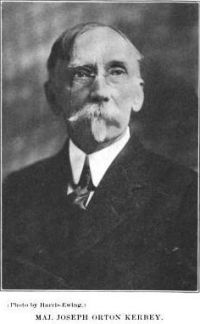
Joseph Orton Kerbey

Joseph Orton Kerbey

Summary

Portrait of Joseph Orton Kerbey Joseph Orton Kerbey The Boy Spy

The Rappahannock, at the point patrolled by our cavalry, was narrow and deep, the banks on either side being abrupt and covered in most places by a close undergrowth of willow. Directly opposite, and within speaking distance, were the Rebel pickets. Their outpost camp-fires were in a little grove of saplings, so close to the bank that, from our side, we could see their every movement at night by the light of their fires, and could count the number of men laying about on the ground. We imagined that we could hear their snores, so close were they. It seemed as if we were on guard over them.
Source: Gutenberg

Portrait of Joseph Orton Kerbey Joseph Orton Kerbey The Boy Spy

A battery pounding shot into an enemy is the most inspiriting music a soldier can hear. Of course, you can not tell whether the shot hit any one or not, as they go so far, but you instinctively feel, from the big noise and fussy kick the thing makes every time it is fired, that something must get hurt at the other end.
As a rule, it is not the artillery that does the damage; the shells most frequently go entirely over the heads of a line of battle and drop far to the rear, where they stampede the mules about the wagon-trains and scare the skulkers.
Source: Gutenberg

Portrait of Joseph Orton Kerbey Joseph Orton Kerbey The Boy Spy

I was so fully satisfied that I was outside the Rebel lines and became so exhilarated with the feeling that came over me upon the thought that the next soldier I should meet would be our own boys in blue, that I started up the hill at a brisk dog-trot, feeling almost as fresh as when starting out in the morning.
This road was through a strip of dense pine woods. You all know how dismally dark the path seems which leads through a deep and dark, lonely wood on a cloudy night.
Source: Gutenberg

Get perspective with Kwize: daily news enlightened by great literature