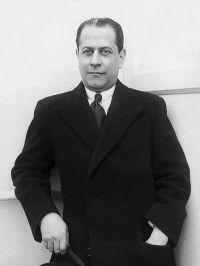
José Raúl Capablanca

José Raúl Capablanca

Summary

Portrait of José Raúl Capablanca José Raúl Capablanca Chess fundamentals — Part I, Chapter I.6… (1921)

This threat makes it impossible for Black to continue the same course. (There is a long analysis showing that Black should lose if he also plays B - Kt 5.) He is now forced to play 7...B × Kt, as experience has shown, thus bringing up to notice three things.
First, the complete development of the opening has taken only seven moves. (This varies up to ten or twelve moves in some very exceptional cases. As a rule, eight should be enough.) Second, Black has been compelled to exchange a Bishop for a Knight, but as a compensation he has isolated White's Q R P and doubled a Pawn.
Source: Wikisource

Portrait of José Raúl Capablanca José Raúl Capablanca Chess fundamentals — Part I, Chapter I.6… (1921)

Black follows the same line of reasoning.
6. P - Q 3P - Q 3
These moves have a two-fold object, viz.: to protect the King's Pawn and to open the diagonal for the development of the Queen's Bishop.
7. B - Kt 5
A very powerful move, which brings us to the middle-game stage, as there is already in view a combination to win quickly by Kt - Q 5.
Source: Wikisource

Get perspective with Kwize: daily news enlightened by great literature