Summary

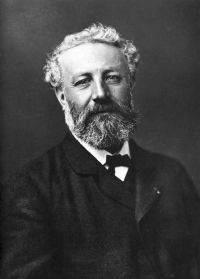
Portrait of Jules Verne Jules Verne 20,000 Leagues Under the Seas… (1870)

At 10:15 Captain Nemo himself took the helm. Dark and deep, a wide gallery opened ahead of us. The Nautilus was brazenly swallowed up. Strange rumblings were audible along our sides. It was the water of the Red Sea, hurled toward the Mediterranean by the tunnel's slope. Our engines tried to offer resistance by churning the waves with propeller in reverse, but the Nautilus went with the torrent, as swift as an arrow.
Source: Wikisource

Portrait of Jules Verne Jules Verne 20,000 Leagues Under the Seas… (1870)

Don't you see a mass that seems to be moving around?"
"Right," I said after observing carefully, "I can make out something like a long, blackish object on the surface of the water."
"A second Nautilus?" Conseil said.
"No," the Canadian replied, "unless I'm badly mistaken, that's some marine animal."
"Are there whales in the Red Sea?" Conseil asked.
"Yes, my boy," I replied, "they're sometimes found here."
"That's no whale," continued Ned Land, whose eyes never strayed from the object they had sighted. "We're old chums, whales and I, and I couldn't mistake their little ways."
Source: Wikisource

Portrait of Jules Verne Jules Verne 20,000 Leagues Under the Seas… (1870)

We fished up the harpoon, and the skiff started off in pursuit of the animal.
The latter returned from time to time to breathe at the surface of the sea. Its wound hadn't weakened it because it went with tremendous speed. Driven by energetic arms, the longboat flew on its trail. Several times we got within a few fathoms of it, and the Canadian hovered in readiness to strike; but then the dugong would steal away with a sudden dive, and it proved impossible to overtake the beast.
I'll let you assess the degree of anger consuming our impatient Ned Land.
Source: Wikisource

Get perspective with Kwize: daily news enlightened by great literature