Summary

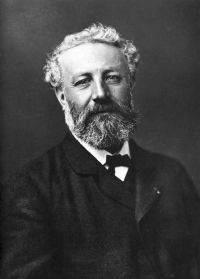
Portrait of Jules Verne Jules Verne 20,000 Leagues Under the Seas… (1870)

Through the windows you could see their enormous mouths paved with teeth, their fearsome eyes. Losing all self–control, Ned Land hurled threats and insults at them. You could feel them clinging to the submersible like hounds atop a wild boar in the underbrush. But by forcing the pace of its propeller, the Nautilus carried them off, dragged them under, or brought them back to the upper level of the waters, untroubled by their enormous weight or their powerful grip.
Finally this mass of sperm whales thinned out.
Source: Wikisource

Portrait of Jules Verne Jules Verne 20,000 Leagues Under the Seas… (1870)

Ned Land went on, "that it wouldn't take much of a crew to run a ship like this one."
"Correct," I replied. "Under existing conditions some ten men at the most should be enough to operate it."
"All right," the Canadian said, "then why should there be any more than that?"
"Why?" I answered.
I stared at Ned Land, whose motives were easy to guess.
"Because," I said, "if I can trust my hunches, if I truly understand the captain's way of life, his Nautilus isn't simply a ship. It's meant to be a refuge for people like its commander, people who have severed all ties with the shore."
Source: Wikisource

Portrait of Jules Verne Jules Verne 20,000 Leagues Under the Seas… (1870)

In '65, just two and a half years ago, I to whom you speak, I myself stepped onto the carcass of a whale near Greenland, and its flank still carried the marked harpoon of a whaling ship from the Bering Sea. Now I ask you, after it had been wounded west of America, how could this animal be killed in the east, unless it had cleared the equator and doubled Cape Horn or the Cape of Good Hope?
Source: Wikisource

Get perspective with Kwize: daily news enlightened by great literature