Summary

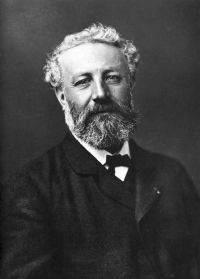
Portrait of Jules Verne Jules Verne,  Around the Moon — Chapter IV (1873)

“ The captain, as a practical man equal to all difficulties, began to write with frightful rapidity. Divisions and multiplications grew under his fingers; the figures were like hail on the white page. Barbicane watched him, while Michel Ardan nursed a growing headache with both hands.
"Very well?" asked Barbicane, after some minutes' silence.
"Well!" replied Nicholl; every calculation made, v zero, that is to say, the speed necessary for the projectile on leaving the atmosphere, to enable it to reach the equal point of attraction, ought to be----"
"Yes?" said Barbicane.
”
Source: Wikisource

Portrait of Jules Verne Jules Verne,  Around the Moon — Chapter IV (1873)

“ What inhabitant of the earth perceives its speed, which, however, is at the rate of 68,000 miles per hour? Motion under such conditions is "felt" no more than repose; and when a body is in repose it will remain so as long as no strange force displaces it; if moving, it will not stop unless an obstacle comes in its way. This indifference to motion or repose is called inertia.
Barbicane and his companions might have believed themselves perfectly stationary, being shut up in the projectile
”
Source: Wikisource

Portrait of Jules Verne Jules Verne,  Around the Moon — Chapter IV (1873)

“ Yes, my worthy friend; taking into consideration all the elements of the problem, the distance from the center of the earth to the center of the moon, of the radius of the earth, of its bulk, and of the bulk of the moon, I can tell exactly what ought to be the initiatory speed of the projectile, and that by a simple formula. ”
Source: Wikisource

Get perspective with Kwize: daily news enlightened by great literature