Summary

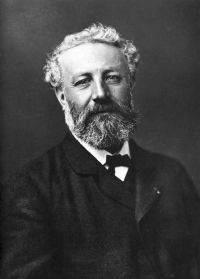
Portrait of Jules Verne Jules Verne Cæsar Cascabel — Part 1, Chapter IX (1890)

In this spot, the Fair Rambler stood on Alaskan territory, fully under Russian dominion, and no longer on the soil of British Columbia. Mr. Cascabel might be free from all uneasiness on this score.
And his good-humor had returned, and in so contagious a manner that it was shared by all his people. Now, all along as far as the boundary of Russia in Europe, the road should lie unceasingly on Muscovite territory. Be they called Alaska, or Siberia, did not these immense countries belong to the Czar?
Source: Wikisource

Portrait of Jules Verne Jules Verne Cæsar Cascabel — Part 1, Chapter IX (1890)

In vain would the eye seek a single star, and the crescent of the new moon had just disappeared behind the lofty mountains at the horizon.
It may have been nine o'clock when Mr. Cascabel gave the order to go to bed. Next morning they should start before daybreak. The Fair Rambler would resume the track it had followed from Sacramento, and even without a guide, it would not be a difficult matter to get along. Once at the springs of the Fraser, the valley would bring them straight on to the frontier of Washington Territory.
Source: Wikisource

Portrait of Jules Verne Jules Verne Cæsar Cascabel — Part 1, Chapter IX (1890)

For, Russia suddenly stood before them under the shape and form of three frontier guards, muscular fellows, with thick beard, large heads, “tip-tilted” noses, a decidedly Kalmuk look about them, wearing the dark uniform of the Muscovite official, and that flat cap which strikes wholesome fear into the hearts of so many millions of human beings.
At a signal from the chief of these guards the Fair Rambler stood still, and Clovy, who drove the horses, called to his master.
Mr. Cascabel appeared at the door of the first compartment and was joined by his sons and his wife.
Source: Wikisource

Get perspective with Kwize: daily news enlightened by great literature