Summary

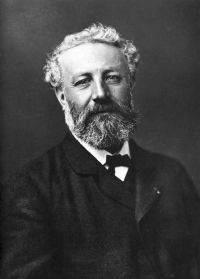
Portrait of Jules Verne Jules Verne From the Earth to the Moon — Chapter IX

I shall surprise our friend Maston, then, by stigmatizing his calculations as timid; and I propose to double his 800,000 pounds of powder."
"Sixteen hundred thousand pounds?" shouted Maston, leaping from his seat.
"Just so."
"We shall have to come then to my ideal of a cannon half a mile long; for you see 1,600,000 pounds will occupy a space of about 20,000 cubic feet; and since the contents of your cannon do not exceed 54,000 cubic feet, it would be half full; and the bore will not be more than long enough for the gas to communicate to the projectile sufficient impulse."
Source: Wikisource

Portrait of Jules Verne Jules Verne From the Earth to the Moon — Chapter IX

Few persons are acquainted with the mechanical power of gunpowder. Now this is precisely what is necessary to be understood in order to comprehend the importance of the question submitted to the committee.
A litre of gunpowder weighs about two pounds; during combustion it produces 400 litres of gas. This gas, on being liberated and acted upon by temperature raised to 2,400 degrees, occupies a space of 4,000 litres: consequently the volume of powder is to the volume of gas produced by its combustion as 1 to 4,000.
Source: Wikisource

Portrait of Jules Verne Jules Verne From the Earth to the Moon — Chapter IX

The size of the projectile, the length of the cannon being settled, what would be the quantity of powder necessary to produce impulsion?
It is generally asserted that gunpowder was invented in the fourteenth century by the monk Schwartz, who paid for his grand discovery with his life. It is, however, pretty well proved that this story ought to be ranked among the legends of the middle ages. Gunpowder was not invented by any one
Source: Wikisource

Get perspective with Kwize: daily news enlightened by great literature