Summary

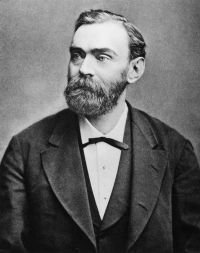
Portrait of Alfred Nobel Alfred Nobel British Patent 27197 (1896) — An improved manufacture of explosive compounds

This invention relates to the manufacture of a smokeless explosive compound, consisting of layers of powder of different chemical compositions, which are of such a nature, and are so arranged relatively to each other, that the combustion is slowest in the outer layer, and increases inwards. The object of this invention is to modify the pressure in the powder chamber and adjacent parts of the guns in which the explosive compound is used, which pressure has a tendency to rise to a dangerous point, owing to the charge being confined in a contracted space.
Source: Wikisource

Portrait of Alfred Nobel Alfred Nobel British Patent 27197 (1896) — An improved manufacture of explosive compounds

Charges for rifles may be produced in the form of tubes, in the same way as is usual for ballistite and similar kinds of explosive, only with the difference that the nozzle of the apparatus used in producing the tubes, is arranged for simultaneously squeezing out several concentric layers of different compositions, which, owing to their plasticity, will appear as only one coherent mass.
Source: Wikisource

Portrait of Alfred Nobel Alfred Nobel British Patent 27197 (1896) — An improved manufacture of explosive compounds

In the firing of explosives made according to the present invention, the gases produced at first are of a comparatively low temperature, as the substances apt to lessen the velocity of combustion, also tend to lower the temperature of the gases produced. This is of great consequence in respect of protecting the bore of the gun from erosion, for, with the high pressure during the first moments of combustion, any increase in temperature greatly increases the danger of erosion.
Source: Wikisource

Get perspective with Kwize: daily news enlightened by great literature