Summary

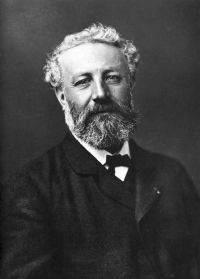
Portrait of Jules Verne Jules Verne From the Earth to the Moon — Chapter VII

Let Providence claim the swiftness of electricity and of light, of the stars, the comets, and the planets, of wind and sound-- we claim to have invented the swiftness of the cannon-ball, a hundred times superior to that of the swiftest horses or railway train. How glorious will be the moment when, infinitely exceeding all hitherto attained velocities, we shall launch our new projectile with the rapidity of seven miles a second!
Source: Wikisource

Portrait of Jules Verne Jules Verne From the Earth to the Moon — Chapter VII

Permission having been granted, "Gentlemen," said he with an inspired accent, "our president is right in placing the question of the projectile above all others. The ball we are about to discharge at the moon is our ambassador to her, and I wish to consider it from a moral point of view. The cannon-ball, gentlemen, to my mind, is the most magnificent manifestation of human power. If Providence has created the stars and the planets, man has called the cannon-ball into existence.
Source: Wikisource

Portrait of Jules Verne Jules Verne From the Earth to the Moon — Chapter VII

Now, at this distance, any objects sixty feet square would be perfectly visible.
"If, then, the penetrative power of telescopes has not been further increased, it is because that power detracts from their light; and the moon, which is but a reflecting mirror, does not give back sufficient light to enable us to perceive objects of lesser magnitude."
"Well, then, what do you propose to do?" asked the general. "Would you give your projectile a diameter of sixty feet?"
Source: Wikisource

Get perspective with Kwize: daily news enlightened by great literature