Summary

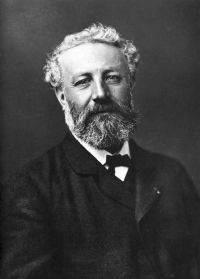
Portrait of Jules Verne Jules Verne From the Earth to the Moon — Chapter VIII

We shall therefore astonish the world by the dimensions we shall be obliged to adopt. It must evidently be, then, a gun of great range, since the length of the piece will increase the detention of the gas accumulated behind the projectile; but there is no advantage in passing certain limits."
"Quite so," said the major. "What is the rule in such a case?"
"Ordinarily the length of a gun is twenty to twenty-five times the diameter of the shot, and its weight two hundred and thirty-five to two hundred and forty times that of the shot."
Source: Wikisource

Portrait of Jules Verne Jules Verne From the Earth to the Moon — Chapter VIII

The problem before us is how to communicate an initial force of 12,000 yards per second to a shell of 108 inches in diameter, weighing 20,000 pounds. Now when a projectile is launched into space, what happens to it? It is acted upon by three independent forces: the resistance of the air, the attraction of the earth, and the force of impulsion with which it is endowed. Let us examine these three forces. The resistance of the air is of little importance. The atmosphere of the earth does not exceed forty miles.
Source: Wikisource

Get perspective with Kwize: daily news enlightened by great literature