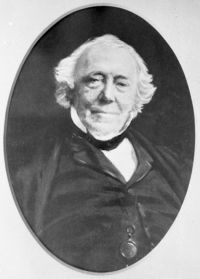
Frederick Bramwell

Frederick Bramwell

Summary

Portrait of Frederick Bramwell Frederick Bramwell Our big guns (1886)

When we consider the mere cost of our fleet and armies in times of peace, involving expenditure upon ships, establishments, small arms. Big Guns, and the experiments connected therewith, are you not prepared to agree with that which I began with? How great the blessings to mankind at large, if nations would cease to covet! but how much more must this truth be impressed upon us, when we consider, not merely the frightful expenditure in time of war, but the loss of life, the misery, and the bar to progress, arising from covetousness!
Source: Wikisource

Portrait of Frederick Bramwell Frederick Bramwell Our big guns (1886)

The facts as regards France, so far as I know them, are that their largest steel guns are of 75 tons weight, and of 161⁄2 inches bore, firing a projectile weighing 1720 lbs., with a muzzle velocity of 1739 feet per second, giving an energy of 36,000 foot-tons. The gun is breech-loading, and is rifled on the increasing twist system, as the English guns are. It is true the French possess a 96-ton gun, but this is largely composed of cast iron, and has only the same bore and ballistics, as the 75-ton steel gun before mentioned.
Source: Wikisource

Portrait of Frederick Bramwell Frederick Bramwell Our big guns (1886)

Let me show you why it is that the erosive power of the gases per unit of surface, must be so much more in a large gun, than it is in a small one. Let us take, say a 6-inch gun and a 12-inch gun, and assume that the linear dimensions of the 12-inch gun are just double, in all respects of bore, powder-chamber, and projectile, those of the 6-inch gun.
Source: Wikisource

Get perspective with Kwize: daily news enlightened by great literature