Summary

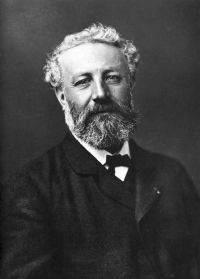
Portrait of Jules Verne Jules Verne,  Mathias Sandorf — Part I, Chapters IX-X (1885)

“ In a dark night they might not be seen; in a noisy night they might not be heard.
As Sandorf had instantly recognized, flight was only possible through the window of the cell. To force the door, to cut into its strong planks of oak, all bound and ironed, was not to be dreamed of. Besides, the step of a sentinel resounded on the flags of the corridor. And once the door was cleared, how were they to find their way through the labyrinth of the fortress? How were they to pass the portcullis and draw-bridges, at which there were always so many men on guard?
”
Source: Wikisource

Portrait of Jules Verne Jules Verne,  Mathias Sandorf — Part I, Chapters IX-X (1885)

“ But what they did not know was that when it left the crest of the plateau on which rose the wall of the donjon, the iron cable became free, floating, abandoned in the void, and its lower end plunged into the waters of the Foiba, then swollen by recent rains. Where they reckoned on finding firm ground at the bottom of the gorge was a foaming torrent, leaping impetuously into the caverns of the Brico. If they had known this, would they then have recoiled from their attempted escape? No.
“Death for death,” said Sandorf. “We may die after doing all we can to escape death.”
”
Source: Wikisource

Portrait of Jules Verne Jules Verne,  Mathias Sandorf — Part I, Chapters IX-X (1885)

“ Who can say what thousands of angles, what forests of pillars supporting the enormous substructure of the fortress and entire city its waters are dashed against in their course? Many bold explorers, when the water-level has been neither too high nor too low, have taken a light boat and endeavored to descend the Foiba through the gloomy tunnel, but the arches have been too low and have soon interposed an impracticable obstacle. ”
Source: Wikisource

Get perspective with Kwize: daily news enlightened by great literature