Summary

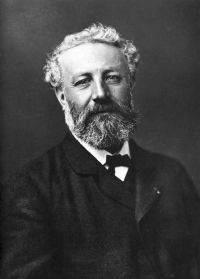
Portrait of Jules Verne Jules Verne,  The Mysterious Island — Chapter 15 (1874)

“ All the patience, all the ingenuity of the settlers was needed; but at last it succeeded, and the result was a lump of iron, reduced to a spongy state, which it was necessary to shingle and fagot, that is to say, to forge so as to expel from it the liquefied veinstone. These amateur smiths had, of course, no hammer; but they were in no worse a situation than the first metallurgist, and therefore did what, no doubt, he had to do.
A handle was fixed to the first lump, and was used as a hammer to forge the second on a granite anvil, and thus they obtained a coarse but useful metal.
”
Source: Wikisource

Portrait of Jules Verne Jules Verne,  The Mysterious Island — Chapter 15 (1874)

“ At length, after many trials and much fatigue, on the 25th of April several bars of iron were forged, and transformed into tools, crowbars, pincers, pickaxes, spades, etc., which Pencroft and Neb declared to be real jewels. But the metal was not yet in its most serviceable state, that is, of steel. Now steel is a combination of iron and coal, which is extracted, either from the liquid ore, by taking from it the excess of coal, or from the iron by adding to it the coal which was wanting. The first, obtained by the decarburation of the metal, gives natural or puddled steel ”
Source: Wikisource

Portrait of Jules Verne Jules Verne,  The Mysterious Island — Chapter 15 (1874)

“ Before anything else could be done it was necessary to make the iron ore, of which the engineer had observed some traces in the northwest part of the island, fit for use by converting it either into iron or into steel.
Metals are not generally found in the ground in a pure state. For the most part they are combined with oxygen or sulphur. Such was the case with the two specimens which Cyrus Harding had brought back, one of magnetic iron, not carbonated, the other a pyrite, also called sulphuret of iron.
”
Source: Wikisource

Get perspective with Kwize: daily news enlightened by great literature