Summary

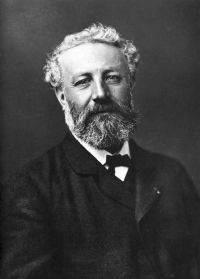
Portrait of Jules Verne Jules Verne The Voyages and Adventures of Captain Hatteras…

Red is a rare color in nature; the reflection of the sun's rays on this crimson surface produced strange effects; it gave the surrounding objects, men and animals, a brilliant appearance, as if they were lighted by an inward flame; and when the snow was melting, streams of blood seemed to be flowing beneath the travellers' feet.
The doctor, who had not been able to examine this substance when he saw it on crimson cliffs from Baffin's Bay, here examined it at his ease, and gathered several bottlefuls of it.
Source: Wikisource

Portrait of Jules Verne Jules Verne The Voyages and Adventures of Captain Hatteras…

So the amazed spectators see wonderful changes in the appearance of the country; the mountain becomes a plain under the action of a sudden thaw; when the rain has filtered into the fissures of the great blocks and freezes in a single night, it breaks everything by its irresistible expansion, which is more powerful in forming ice than in forming vapor: the phenomenon takes place with terrible swiftness.
No catastrophe, fortunately, threatened the sledge and its drivers
Source: Wikisource

Portrait of Jules Verne Jules Verne The Voyages and Adventures of Captain Hatteras…

Scoresby tells us that in the course of a single summer thirty whalers have been lost in this way in Baffin's Bay; he saw a three-master crushed in one minute between two walls of ice, which drew together with fearful rapidity and sank the ship with all on board. Two other ships he himself saw cut through, as if by a long lance, by huge pieces of ice more than a hundred feet long.
A few moments later the whale-boat returned to the brig, and was hauled up to its usual place on deck.
“That's a lesson,” said Shandon, aloud, “for those who are foolhardy enough to venture into the passes!”
Source: Wikisource

Get perspective with Kwize: daily news enlightened by great literature